In a nutshell
- Green comes from oxygen at 100-150km, red from oxygen above 200km and violet from ionized nitrogen below 100km.[1]
- Rovaniemi has visible aurora roughly 8 months a year, from late August through mid-April.[2]
- The tour booked from this site runs 8 hours for a small group limited to 8 participants, and is priced from US$228.[3]
- January in Rovaniemi averages between -30 and -15 degrees Celsius, and a damp cotton base layer defeats an insulated suit.[4][5]
- Solar Cycle 25 is expected to have a double peak, extending the window for aurora activity well into 2026.[6]
- Top choice Guaranteed sightings tour from US$228 Rated4.64 from 4,381 reviews[3]Duration8 hours[3]Group sizeLimited to 8 participants[3]CancellationCancel up to 24 hours ahead[3]PickupPickup included[3] Check availability
- Wilderness small-group tour from US$148 Rated4.34 from 1,530 reviews[7]Duration4 hours[7]Group sizePrivate or small groups[7]CancellationCancel up to 24 hours ahead[7]PickupPickup included[7] See this tour
- Aurora hunt with photos from US$80 Rated4.85 from 1,296 reviews[8]Duration5 - 8 hours[8]Group sizePrivate or small groups[8]CancellationCancel up to 24 hours ahead[8]PickupPickup available[8] See this tour
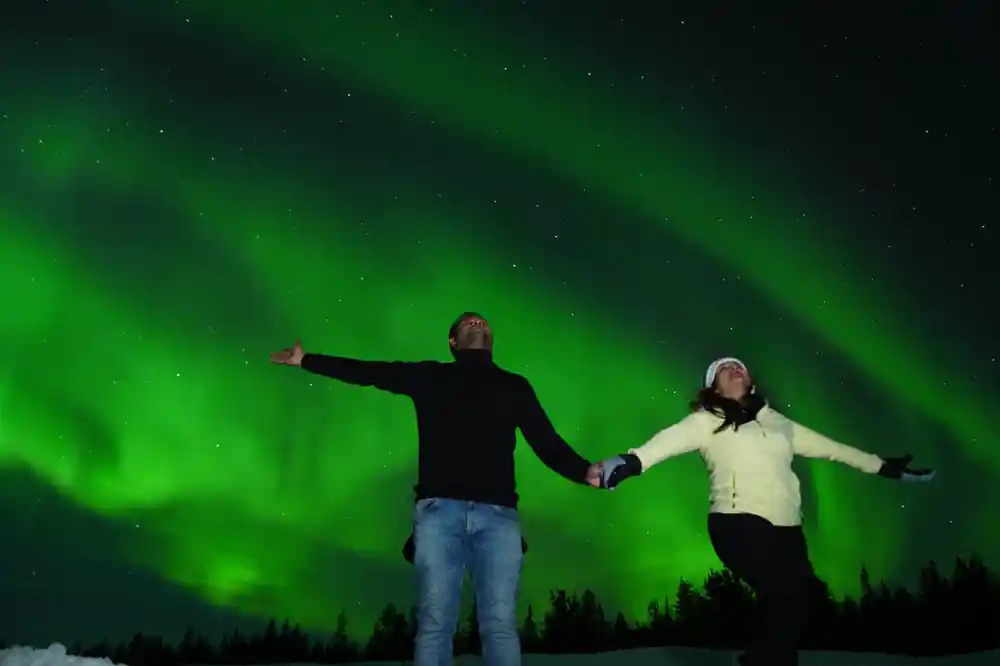
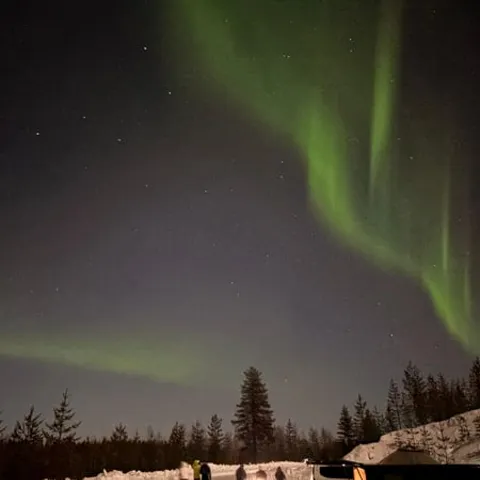
When the fast moving electrons, traveling nearly 1/10th the speed of light (20,000 km/sec or 44 million mph), collide with atoms and molecules in Earth's upper atmosphere (above 100 km or 60 miles) they transfer energy to the atmosphere which "excites" the atom or molecule to higher energy states.
Rare Forms Reward Patience and Warm Clothes
Read before booking
The Substorm Breakup: When the Aurora Erupts
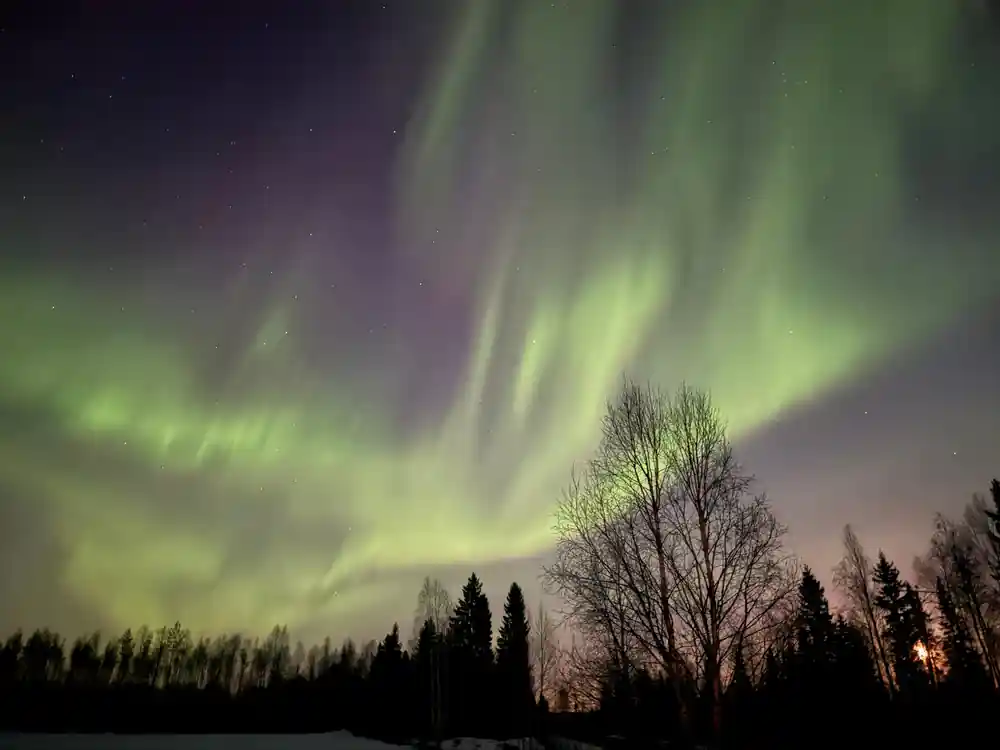
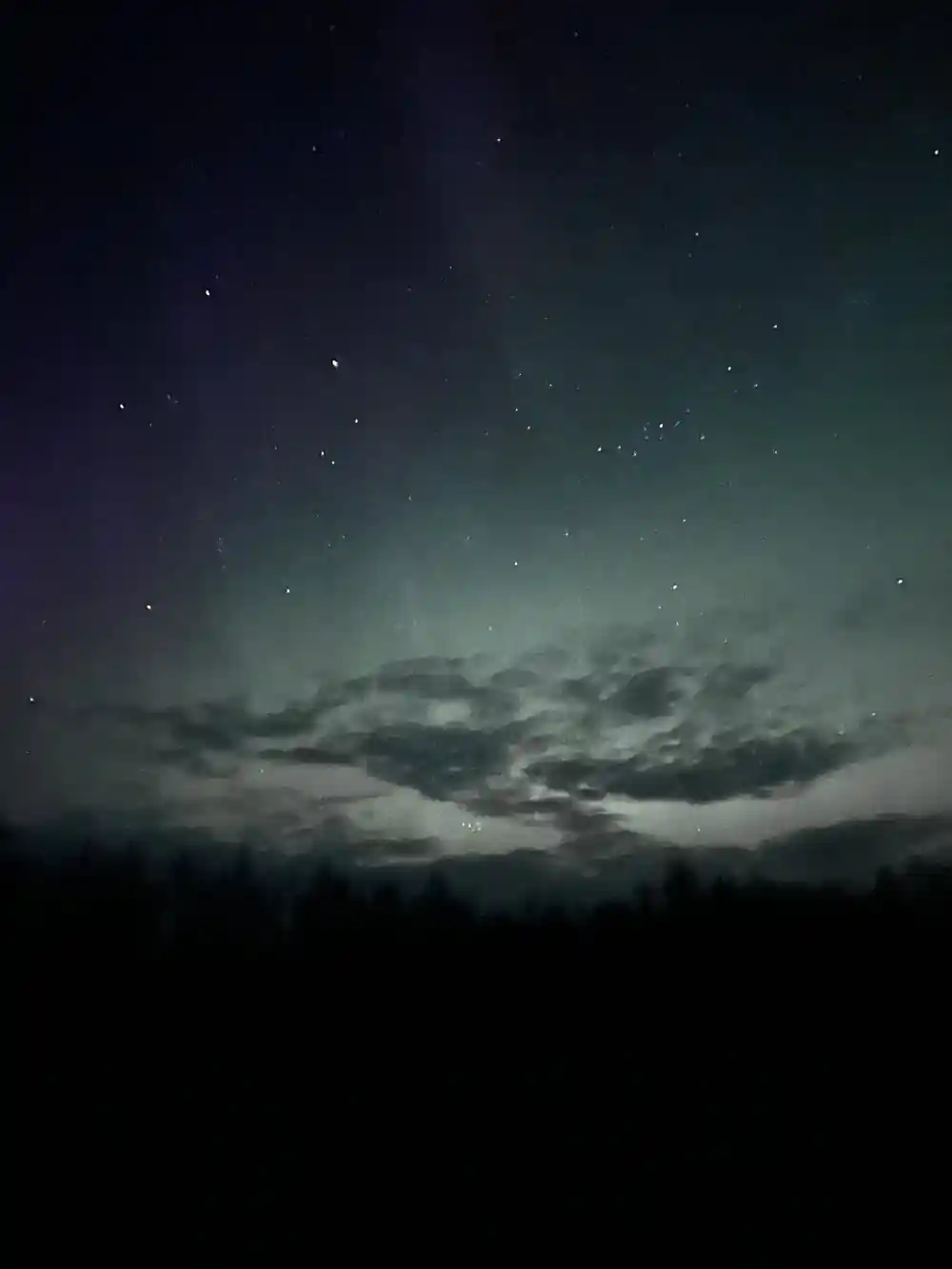
Most aurora nights begin quietly. A pale arc sits low in the north, faint enough that a glance at a phone screen will wipe it out. Then a bright patch can appear on one side of the arc, the whole band brightens, and thin rays shoot upwards. That sudden change is the substorm breakup, and it is the moment when the rarest forms tend to appear. Underneath it, fast-moving electrons are colliding with atoms and molecules in Earth's upper atmosphere above 100 km (60 miles), transferring energy that excites them to higher energy states.[9]
Breaking up is not a slow process. A quiet arc can turn into a full curtain while you are changing a camera battery, and it can fade back just as quickly. Forecasters describe the disturbance with the Kp index, which ranges from 0 to 9; for Kp 0-2 the aurora will be far north, quite dim in intensity, and not very active.[10] In Rovaniemi you are already far north, so a low number is not a reason to go indoors. It is a reason to expect a soft arc rather than an explosion, and to keep watching.
Aurora Dunes: The Ripple on the Lower Edge
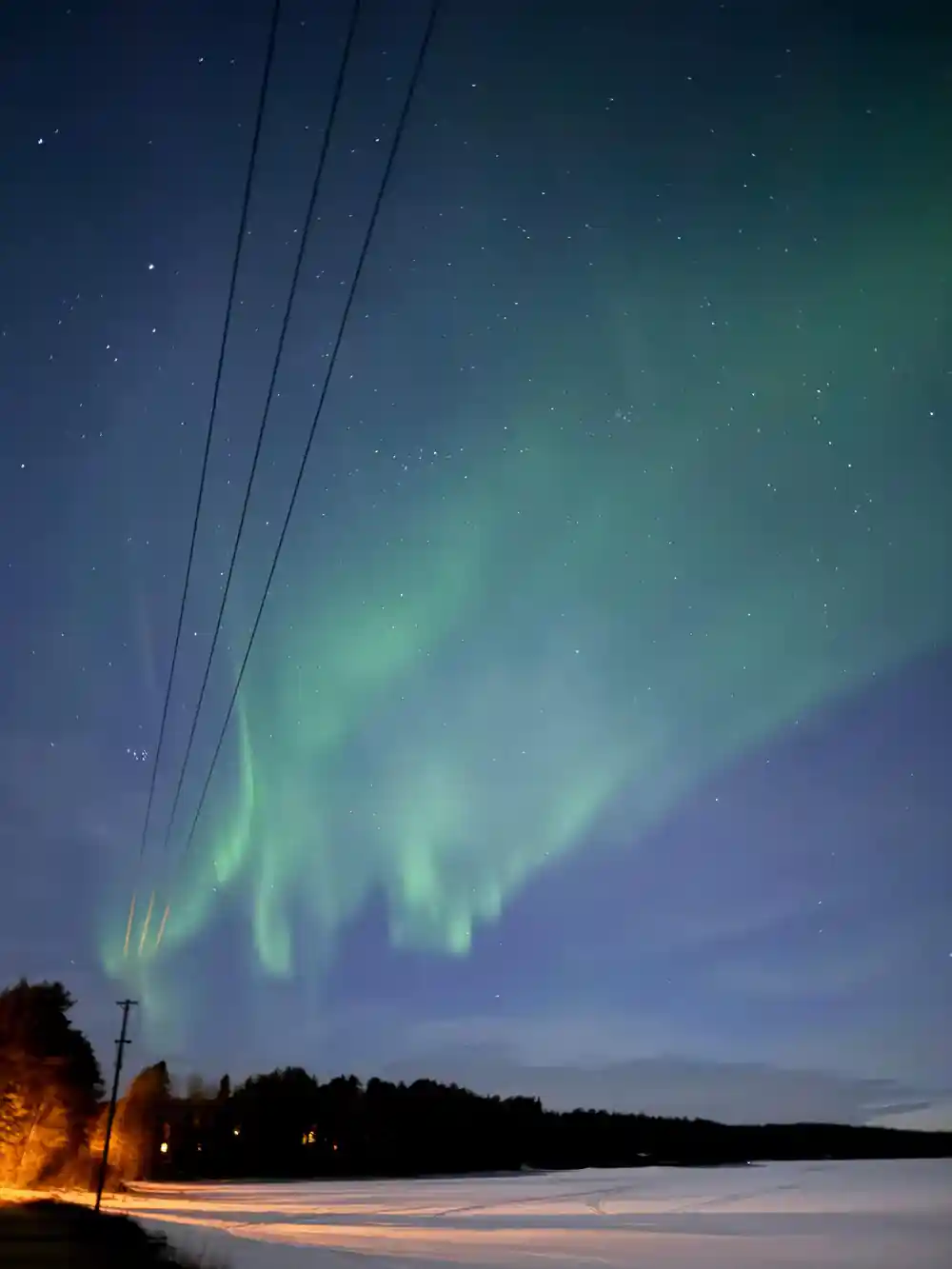
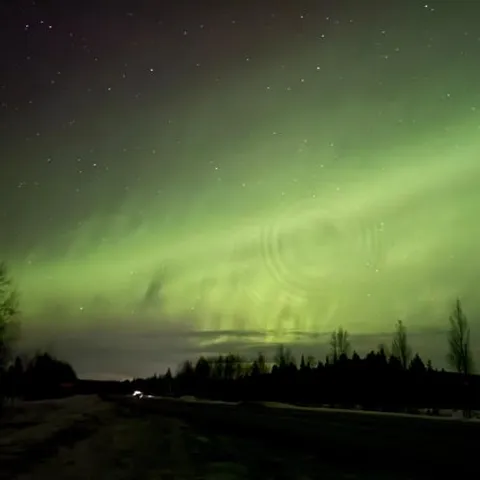
Look along the lower edge of a bright band and you may catch a row of small regular ripples, like the marks a rake leaves in sand. These are aurora dunes, a rare form that usually lasts only a few minutes and is easy to miss if you are watching the big shapes instead. They tend to turn up in the middle of an active display, when the aurora has already brightened and started to fold. Photographers chase them because the pattern is fine: a wide lens can lose the whole thing.
Dunes are not the only shape that appears at the edge of what most people expect. STEVE, or Strong Thermal Emission Velocity Enhancement, is a narrow mauve ribbon that shows far equatorward of the auroral oval, produced by a roughly 5 km/s channel of westward-drifting ions heating the atmosphere rather than by particle precipitation.[11] From Rovaniemi it is a bonus rather than something to plan a trip around, and it rarely stays long enough for a second attempt.
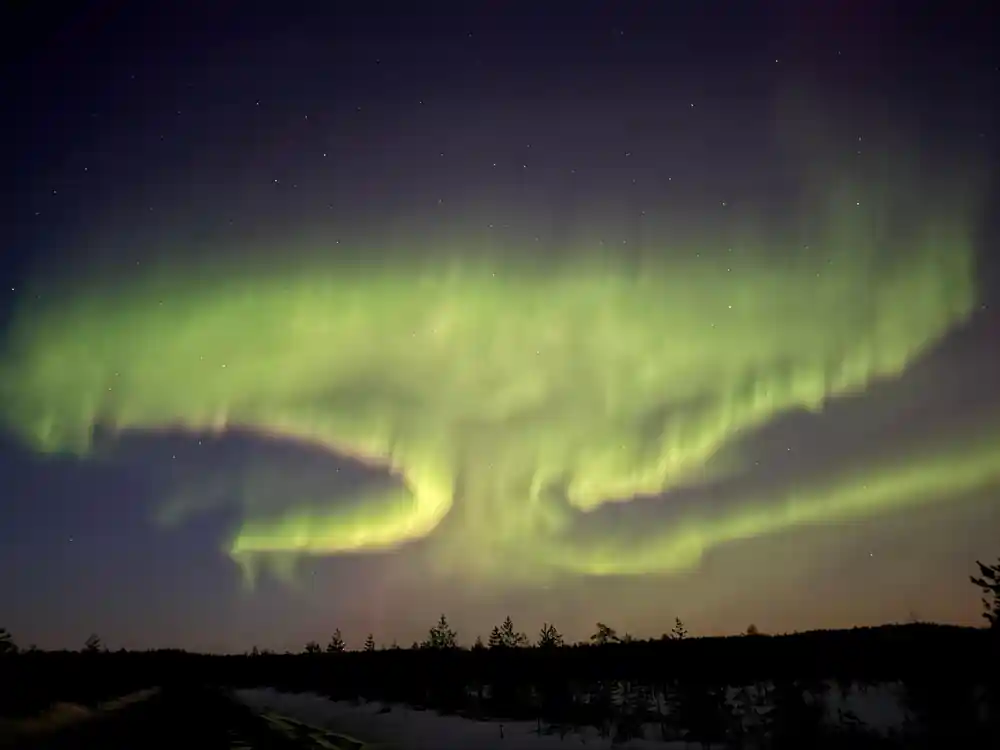
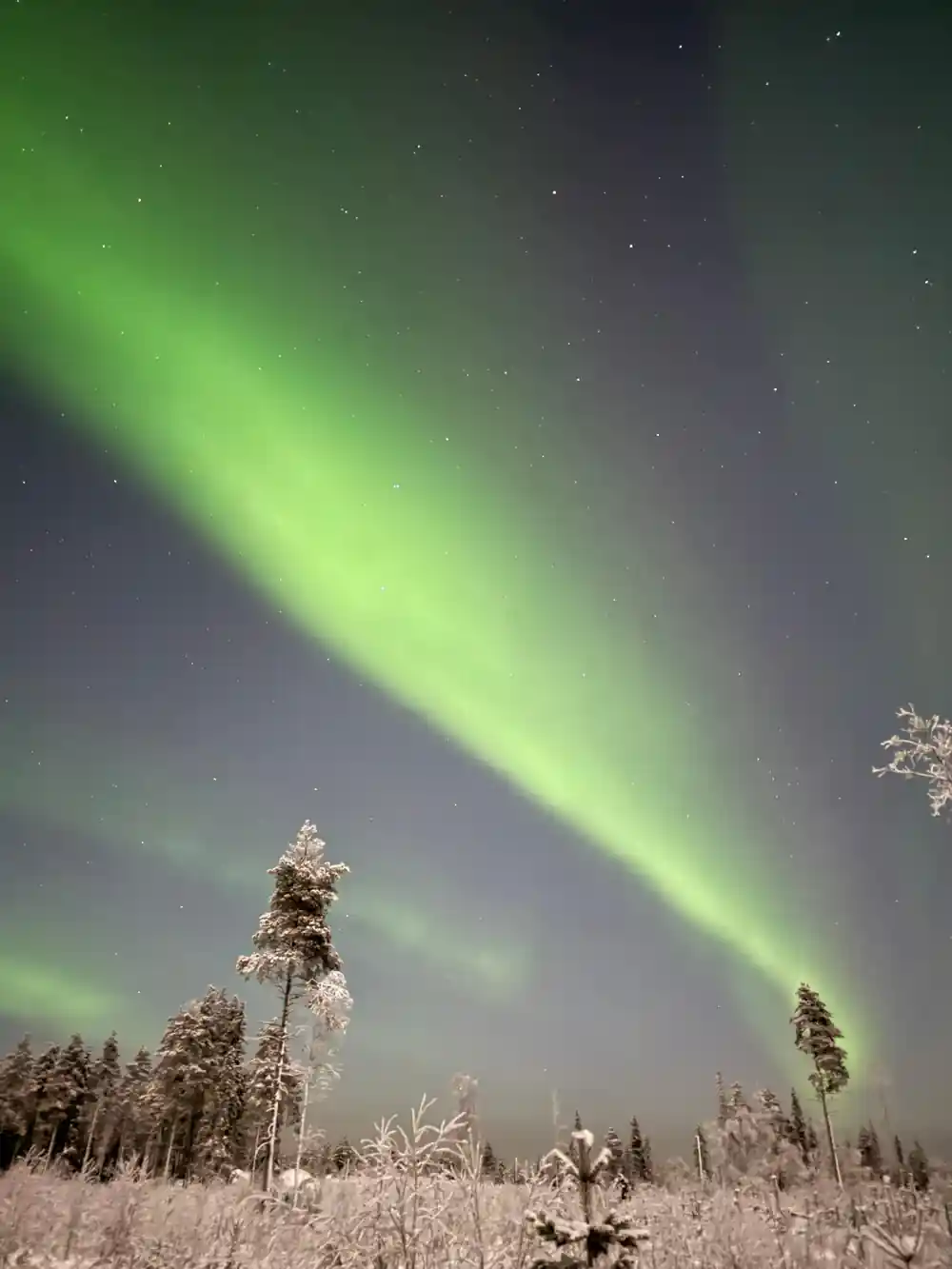
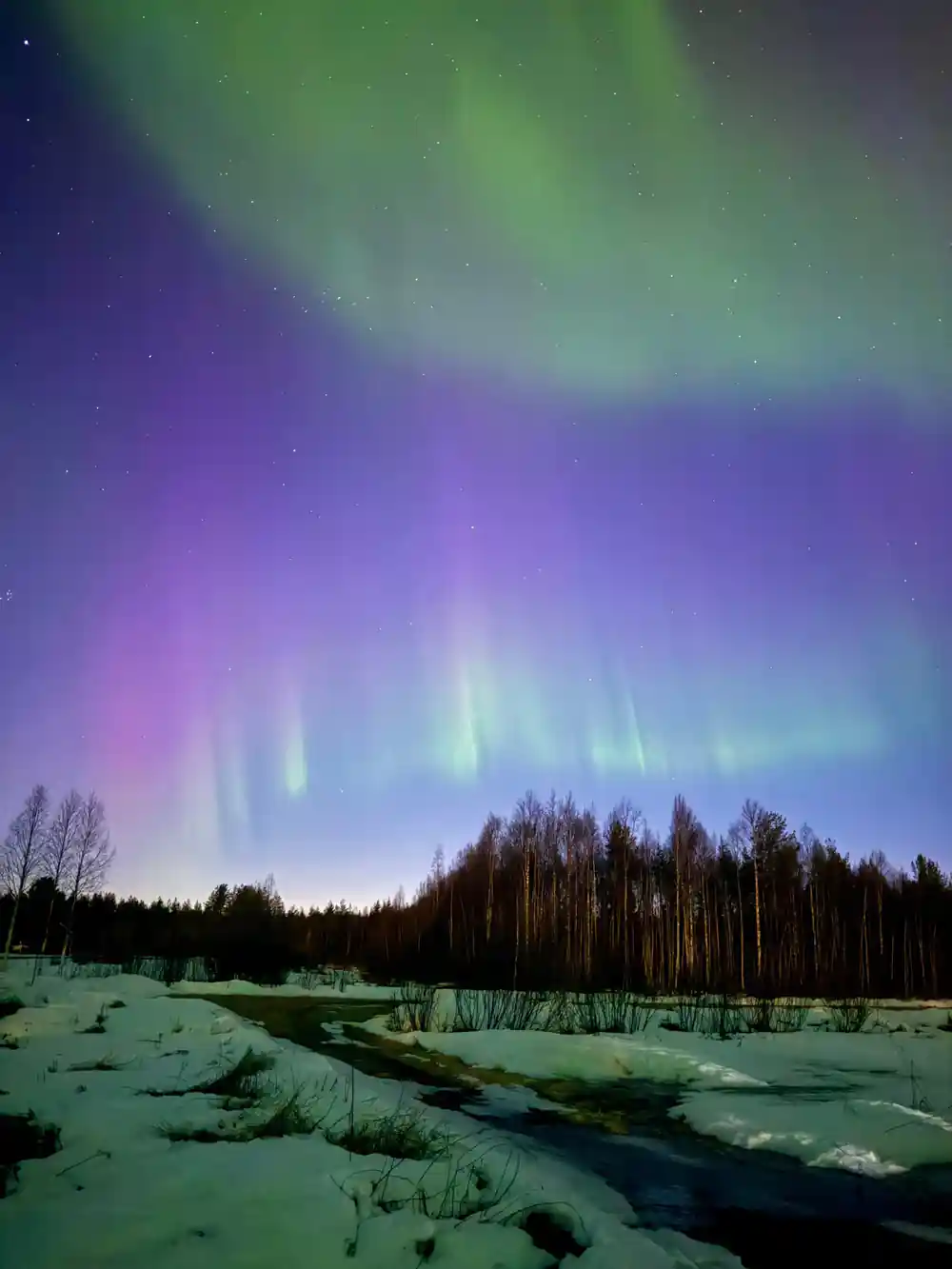
A green curtain folding over the treeline north of Rovaniemi.
The Corona: Aurora Directly Overhead
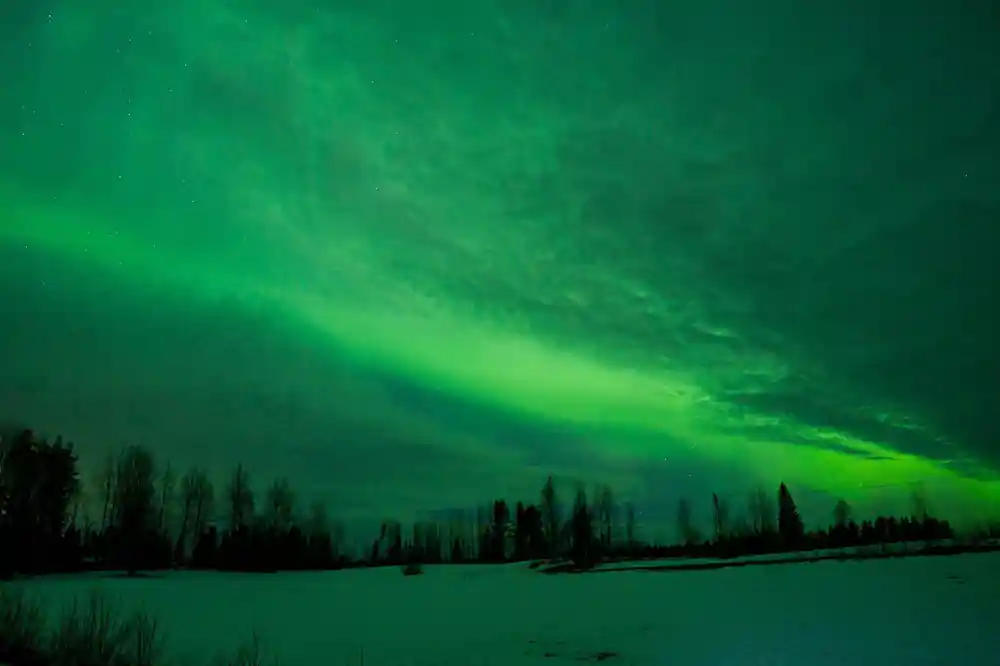
When a bright band passes over your head, the perspective changes completely. Instead of a curtain hanging in the north, you see rays converging on a point almost above you, like the spokes of a wheel or the inside of a burning crown. This is the corona, and it only appears when the aurora is directly overhead, which is why many regular watchers have never seen one. How northern lights look in a corona is nothing like the flat green band on a postcard: the structure is sharper, the colour is deeper, and the whole sky seems to be moving at once.
Standing under a corona also means you are under the most active part of the oval, so it is a good moment to stop fiddling with settings and simply look up. Colour is worth watching here. The green that fills most displays comes from oxygen at 100-150km, the deep red glow higher up comes from oxygen above 200km, and the violet fringe at the base is ionized nitrogen below 100km.[1] Those layers sit one above the other, so a single bright curtain can show several colours at once.
Black Aurora: The Northern Lights Without Color
The strangest form of all is the one you see by not seeing it. Inside a bright curtain, dark patches and black curls sometimes appear, sharper and more structured than a cloud shadow. People call this black aurora. It is not a gap in the display and not the sky showing through, but a place where the aurora is switched off while everything around it keeps glowing. On a camera it reads as a clean dark stripe across the green, and to the eye it looks like a hole punched in the middle of the light.
It is the northern lights without color, and it is a good reminder that the aurora is not a flat picture. Photographing it is a test of technique: a long exposure smears the dark shape, and a very short one loses the surrounding glow. Watch for it in the brightest minutes of a substorm, when the curtain is thick enough for a hole to stand out. Dark shapes that drift with the aurora belong to the aurora; shapes that sit still while the curtain moves are more likely to be cloud.
from US$228
The tour booked here is from US$228, runs 8 hours and keeps the group to 8 participants.[3]
Curtain Speeds: How Fast the Light Moves
Ask how fast the aurora moves and you will get a range rather than an answer. Rays can brighten and fade in a second or two, while the big folds that sweep across a display take minutes to travel from one side of the sky to the other. The quickest thing you will see is usually the shimmer along the lower edge of a curtain, which is what makes timelapse footage so dramatic and single frames so unpredictable.
For planning, motion matters more than brightness. A display that keeps moving is a display that is still being fed energy, and a smooth, frozen arc often means the show has settled between active phases. Watch for the moment the arc begins to fold. That is when the photogenic forms, the corona, the dunes and the black patches, are most likely to appear, and when a guide who is willing to drive is worth the money.
The Aurora Sounds Debate
Ask a group standing on a frozen lake whether they can hear the aurora and you will get two firm answers. Some people report a faint crackling, a rustle or a distant clap during the brightest moments. Others hear nothing at all, and some of what people hear is their own clothing, their breath and the sound of blood in their ears. It is the friendliest argument in aurora watching, and nobody is going to settle it on a single night out.
Finland has its own answer in the language. The Finnish word for aurora borealis is "revontulet", which literally means "fox fires", and a Sami legend tells that the lights are caused by a magical fox running across the Arctic fells.[12] Whether or not you hear anything, it is a good name for a night out: a fire that moves, gives no heat, and leaves nothing behind.
Watching Rare Forms From Rovaniemi
Rovaniemi sits on the Arctic Circle, which runs through Santa Claus Village, eight kilometres north of the city centre, where it is clearly marked.[13] The season is long: Rovaniemi has visible aurora roughly 8 months a year, from late August through mid-April.[2] That is a long window, and it gives a chase plenty of nights to work with, though clear skies and a late hour still do most of the work.
Darkness is rarely the problem. In Rovaniemi the polar night lasts for 2 days, and the nights either side of it are long.[14] The city itself is busy: Rovaniemi recorded 1.2 million overnight stays in 2023, up 30% on 2022, with December peaks of up to 10,000 airport arrivals per day, and Santa Claus Village receives over 600,000 visitors a year.[15] Light from the centre is the main reason to head out of town or join a guided hunt.
Snow is not the obstacle either. Rovaniemi typically receives 150-200 cm of snowfall per winter, and the snowy part of the winter can last 6-7 months.[16] Roads are kept open, but animals are not always off them: according to the Reindeer Herders Association in Finland, there were 186,776 reindeer in Finland in the reindeer husbandry year 2013-14.[17] If you would rather watch the sky than the verge, a night out with pickup and a small group takes the driving out of your hands.
Days of polar night, from Rovaniemi northwards
Length of the polar night at Rovaniemi, at Ylläs and at Utsjoki, as stated in[14].
Aurora tours from Rovaniemi: from-prices
US dollar from-prices per person from GetYourGuide listings[3],[7],[18] and[8].
When to chase rare aurora forms
How to spot rare forms
Get away from town lights
Streetlights flatten faint structure. A dark shore, a forest road or a guided chase gives the fine shapes a chance to show.
Look at the whole sky
Rare forms appear overhead and behind you as often as in the north. Turn around every few minutes and look straight up.
Stay for the active phase
Watch for the arc brightening and folding. That is when breakups, dunes and black patches tend to appear.
Dress in layers, not cotton
An insulated thermal suit can be rated to minus 40, but a damp cotton base layer defeats its insulation.[5]
Keep the camera simple
A fast lens and short exposures hold the detail in dunes and black aurora better than long, smeared frames.
Turn a clear night into an eight-hour aurora chase
from US$228Reserve now & pay later