In a nutshell
- A weak display over an open sky still reads clearly, while a strong one behind cloud shows nothing. Watch the cloud layer before the strength number.
- The Kp index runs from 0 to 9, and at Kp 0-2 the aurora stays far north, dim and not very active.[1]
- Rovaniemi has visible aurora roughly 8 months a year, from late August through mid-April.[2]
- January averages between -30 and -15 degrees Celsius, and a damp cotton base layer defeats an insulated suit.[3][4]
- The guaranteed sightings tour runs 8 hours, with a group limited to 8 participants and a refund if viewing is impossible.[5]
- Top choice Guaranteed Sightings from US$228 Duration8 hours[5]Rating4.64 from 4,381 reviews[5]PickupPickup included[5]Free cancellationUp to 24 hours in advance[5] Check availability
- Small-Group Wilderness from US$148 Duration4 hours[6]Rating4.34 from 1,530 reviews[6]PickupPickup included[6]Free cancellationUp to 24 hours in advance[6] See this tour
- Snowmobile Aurora Safari from US$160 Duration4 hours[7]Rating4.33 from 1,135 reviews[7]PickupPickup included[7]Free cancellationUp to 24 hours in advance[7] See this tour
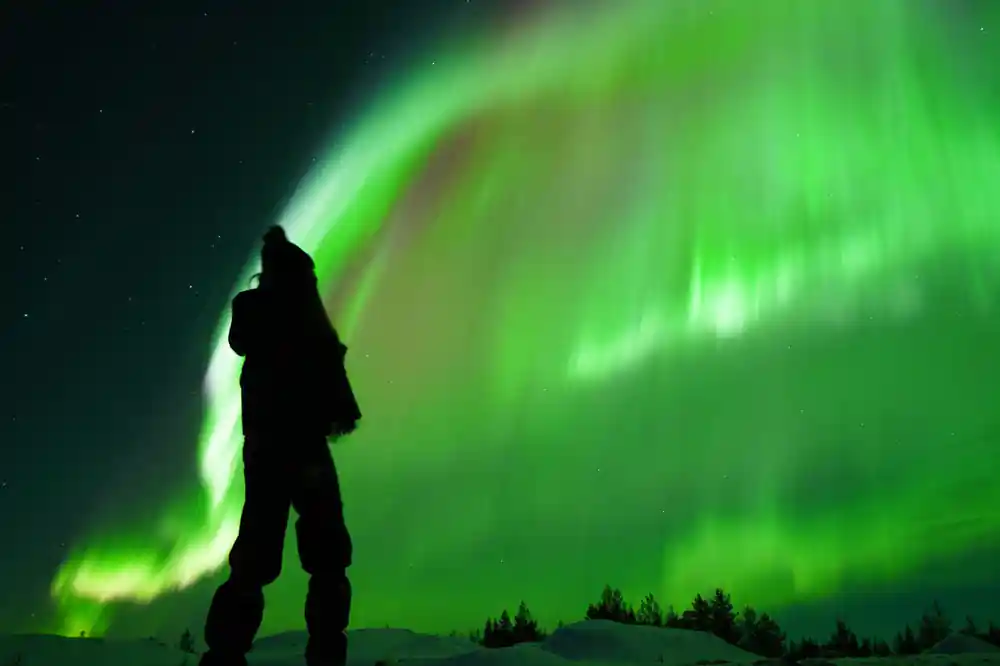
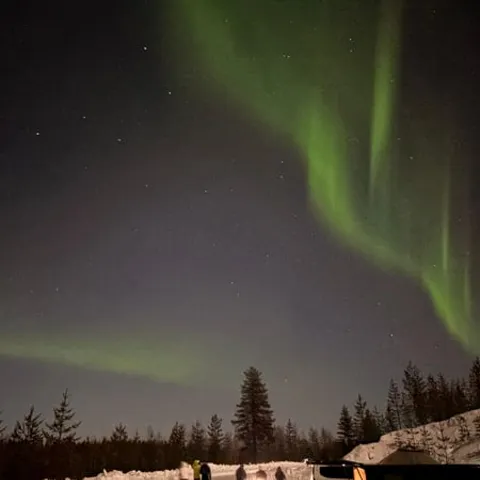
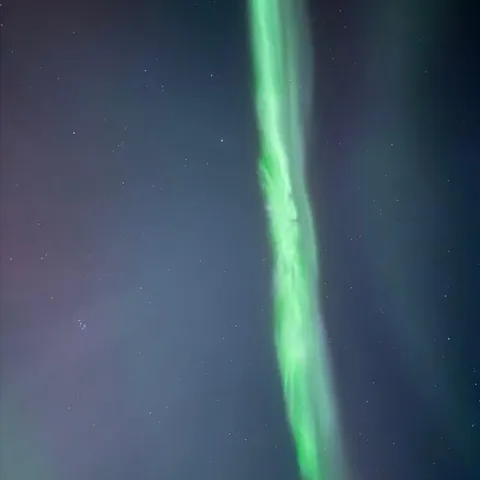
The Kp index ranges from 0 to 9. For Kp in the range 0 to 2, the aurora will be far north, quite dim in intensity, and not very active.
Should you book the guaranteed sightings tour?
Ahead of the trip
Why cloud cover matters more than solar activity
Every aurora forecast is really a pair of forecasts stapled together: how much energy is arriving from space, and whether the sky above you will be clear when it gets there. The second one decides most nights. A modest display over an open frozen lake is unmistakable, while a spectacular one behind a solid deck of cloud leaves you with nothing but a grey smudge on the horizon. Guides in Lapland talk about the cloud map long before they talk about the numbers.
Auroras are caused when fast-moving electrons collide with atoms and molecules in Earth's upper atmosphere above 100 km (60 miles), transferring energy that excites them to higher energy states.[8] All of that happens high above the weather, which is exactly the problem. The glow can be blazing up there while the air between you and it is thick with water droplets. Cloud is the one variable a guide can still beat, by driving somewhere else. Solar activity is not something anyone can argue with.
There is a rhythm to a good aurora night. You drive, you stop, you stand in the dark and let your eyes adjust, and then you decide whether to stay or move on. Guides who do this every winter read the radar and the sky at the same time, and they will happily abandon a spot that looked promising on a screen.
What your northern lights forecast tonight can and cannot say
Most public forecasts hand you one headline number, the Kp index. It ranges from 0 to 9, and for Kp 0-2 the aurora will be far north, quite dim in intensity, and not very active.[1] Read that carefully. It does not mean nothing will happen over Rovaniemi; it means the display will sit nearer the pole, and Rovaniemi already sits far enough north to be underneath it on plenty of nights.
The Kp figure also moves in real time and is often reported with a delay, so what you read at dinner may describe the sky from earlier. Local guides watch magnetometers, all-sky cameras and satellite imagery together, then decide whether the fuel is worth spending. Solar Cycle 25 is expected to have a double peak, which will extend the window for aurora activity well into 2026,[9] so the background odds stay reasonable for a while yet.
One more thing about the number on your phone: it is usually given for a wide region, not for the patch of sky above your head. A Kp reading covers the whole auroral oval, and a small, bright substorm can flare directly overhead in Rovaniemi while the index barely twitches. That is why guides trust their eyes and their cameras more than a headline figure once the van stops.
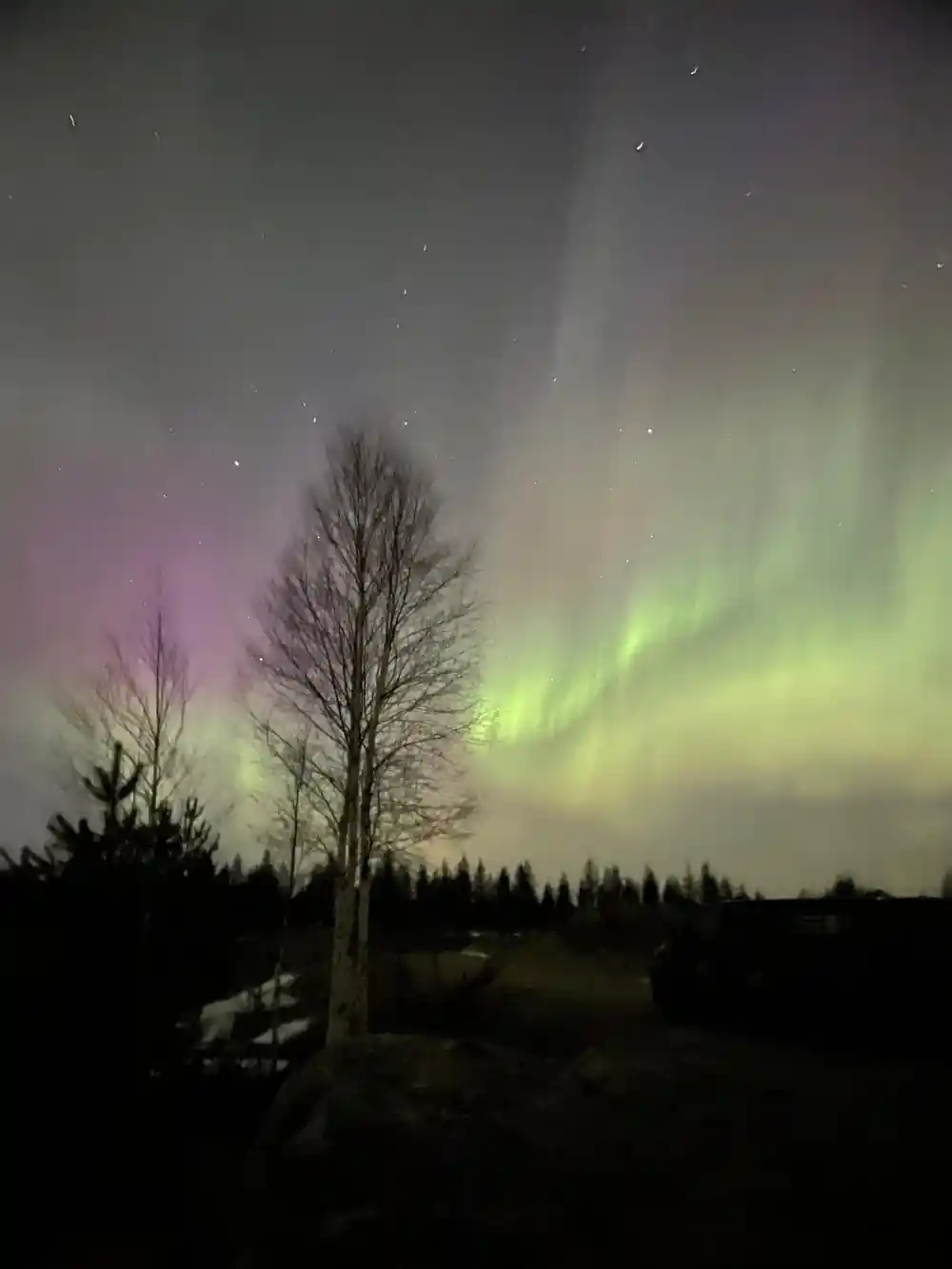
A gap in the cloud is all it takes, and the van is already pointed at it.
Which apps and maps guides actually use
Ask a guide what is on their phone and you get a short list: a cloud model you can refresh whenever you like, a satellite loop you can scrub backwards, an all-sky camera pointed at the sky right now, and a magnetometer reading for the region. The apps most people download at the airport show a bright green blob across the whole of Lapland, which says almost nothing about your particular evening.
Any northern lights forecast map worth opening puts cloud in the main layer and draws the aurora oval underneath it. If you are learning to read one, start with the cloud: find the breaks, watch the direction the deck is drifting, and look for coastlines or fells where the air is forced upward and the cloud thins. A northern lights tracker that plots only the oval will keep you indoors on the wrong night and send you out on a worse one.
You can do all of this yourself with a phone, a data connection and a bit of practice, and it is genuinely satisfying. It also takes time you may not have on a short visit, and it cannot tell you which forest track is ploughed or where the horizon opens up. That local knowledge is the part that is hard to download.
How moonlight affects your viewing experience
A bright moon is not the enemy it is sometimes made out to be. It lifts the landscape out of pure black, so you can see the trees, the snow and the shape of the fells instead of a void. What it does do is raise the background brightness, and faint, low-contrast aurora can wash out against a moonlit sky. Strong, fast-moving displays punch through moonlight without any trouble.
The moon rises, sets and changes phase through the month, so a night that looks hopeless early can be excellent later. Guides work with it rather than around it. They steer towards the darker part of the sky, use moonlit snow as a foreground for photographs, or simply wait for the moon to drop behind a ridge. On a photography-focused night, moonlight is often an asset.
One practical note: give your eyes time to adjust. It takes a while in darkness before you see faint detail, and a phone screen or a headtorch on full beam resets that clock. If you are checking a cloud map mid-night, turn the brightness right down and hold the screen low.
from US$228
The guaranteed sightings tour runs 8 hours, is limited to 8 participants, and refunds you if viewing is impossible.[5]
How guides choose where to drive each night
The decision starts in the afternoon, not at pickup. Guides compare several cloud models, look for agreement between them, and work out how far the van will have to travel to reach the nearest clear window. Rovaniemi sits inside a road network that runs north, south, east and west, so there is usually somewhere to go. The distance still matters, and so does the time of year.
Snow depth is part of the calculation. Rovaniemi typically receives 150-200 cm of snowfall per winter, and the snowy part of the winter can last 6-7 months.[10] That means forest tracks closed to ordinary cars, unploughed laybys and, at some temperatures, road surfaces that need real care. A local driver knows which turnings are passable in deep winter and which ones are not.
The Arctic Circle runs through Santa Claus Village, eight kilometres north of the city centre, where it is clearly marked.[11] It makes a useful mental marker. On many nights the drive heads past it and keeps going, because the further you travel from the town's light dome, the darker the sky above the windscreen becomes.
Which hours of the night offer the strongest displays
Aurora is not a switch that flips at midnight. It arrives in bursts, driven by how the solar wind couples with the magnetosphere, and a single burst can last minutes or run for hours. On a long guided night you simply catch more of them. The tour from this site runs for 8 hours, which is far more sky than a short evening trip can offer.[5]
In practice, the deep hours of the night are the ones people remember, but nothing guarantees that, and plenty of good displays arrive before bedtime. What matters as much as timing is patience and warmth. If you are cold and watching the clock, you go home early and miss the best part. Warm boots, a windproof outer layer and a flask of something hot change the arithmetic.
If you are on a tour, the schedule is built around this. Guides will often stop somewhere sheltered, set up, and wait rather than chasing every flicker on the horizon. Waiting is part of the work, and the nights that feel slow at the time are frequently the ones that produce the photograph everyone posts afterwards.
How long-range forecasts lose their edge
A forecast for one specific night far in advance is close to useless. Cloud models that perform well over the coming hours degrade quickly, and aurora is driven by events on the Sun that are hard to pin down even shortly ahead. What you can plan a long way in advance is the season. Rovaniemi has visible aurora roughly 8 months a year, from late August through mid-April.[2]
What you can also plan is your tolerance for cold. In January, the average temperature in Rovaniemi is between -30 and -15 degrees Celsius.[3] Those are not freak numbers, they are the ordinary range, and they shape what you pack and how long you can stand still. The town fills up at the same time: Rovaniemi recorded 1.2 million overnight stays in 2023, up 30% on 2022, with December peaks of up to 10,000 airport arrivals per day.[12]
None of that is a reason to stay home. It is a reason to book the long night, pack the right layers and treat any forecast as a starting point rather than a verdict. A guide with a cloud map, a full tank and a long night ahead will always beat an app on a phone.
How long the polar night lasts
Days of polar night (kaamos) at three places in Lapland, with Rovaniemi on the Arctic Circle line.[13]
Compare from-prices in US dollars
From-prices in US dollars for these GetYourGuide listings.[5][6][7][14]
When to plan your aurora night
How to read the sky tonight
Check cloud first
Look at the cloud layer first. A solid deck makes the strength of the display irrelevant, so find where it breaks and which way to drive.
Read the Kp number
Kp 0-2 means the aurora stays far north, quite dim and not very active, which is often still enough over Rovaniemi.[1]
Give it time
Displays come in bursts. Plan to be outside for hours rather than minutes, because the strongest spell of the night cannot be scheduled.
Get away from the lights
Town glow flattens faint aurora. Even a short drive past Santa Claus Village, eight kilometres north of the centre, darkens the sky.[11]
Stay warm and patient
A damp cotton base layer defeats even a suit rated to minus 40, so dress in wool or synthetic and you will stay out longer.[4]
Let a local guide find the gap in the clouds tonight
from US$228Reserve now & pay later