In a nutshell
- The Arctic Circle runs through Santa Claus Village, eight kilometres north of the city centre, and is clearly marked, so you can walk across it.[1]
- Rovaniemi's polar night lasts for 2 days, a short blue twilight rather than the weeks of darkness people expect further north.[2]
- Visible aurora roughly 8 months a year, from late August through mid-April, with a Solar Cycle 25 double peak extending activity into 2026.[3][4]
- January averages between -30 and -15 degrees Celsius, and winters bring 150-200 cm of snowfall that can lie for 6-7 months.[5][6]
- The tour this site books runs 8 hours for a small group limited to 8 participants, from US$228, with a refund if conditions are impossible.[7]
- Top choice Guaranteed sighting from US$228 Duration8 hours[7]Rating4.64 from 4,381 reviews[7]GuideEnglish[7]Free cancellationUp to 24 hours in advance[7] Check availability
- Wilderness tour from US$148 Duration4 hours[8]Rating4.34 from 1,530 reviews[8]GuideEnglish[8]Free cancellationUp to 24 hours in advance[8] See this tour
- Aurora snowmobile from US$160 Duration4 hours[9]Rating4.33 from 1,135 reviews[9]GuideEnglish[9]Free cancellationUp to 24 hours in advance[9] See this tour
In Rovaniemi, which situates in the Arctic Circle line, the polar night lasts for 2 days, in Ylläs (160 km north from Rovaniemi) 16 days and in Utsjoki (465 km north from Rovaniemi) 52 days.
Is a winter trip to Rovaniemi worth it?
Read before booking
- Check whether your dates fall in the aurora season or in the Christmas rush
- Compare what each tour promises if the sky stays empty on the night
- Ask where pickup happens and how far that is from your accommodation
- Match the group size to the way you like to travel
On the night
- Wear wool or synthetic next to the skin and pack a dry spare layer
- Give your eyes several minutes to adjust before you judge the sky
- Tell your guide early if you are getting too cold to enjoy the wait
- Expect a long evening out, well past the time you would normally turn in
Where the Arctic Circle cuts through Rovaniemi
The Arctic Circle is not a fence or a monument. It is a line of latitude, and in Rovaniemi it happens to run through Santa Claus Village, eight kilometres north of the city centre, where it is clearly marked.[1] In winter the paint is usually buried, but the crossing stays visible and stepping over it takes no time at all. What you are crossing is the boundary that decides how much sun midwinter gives you and how much midnight light arrives at midsummer.
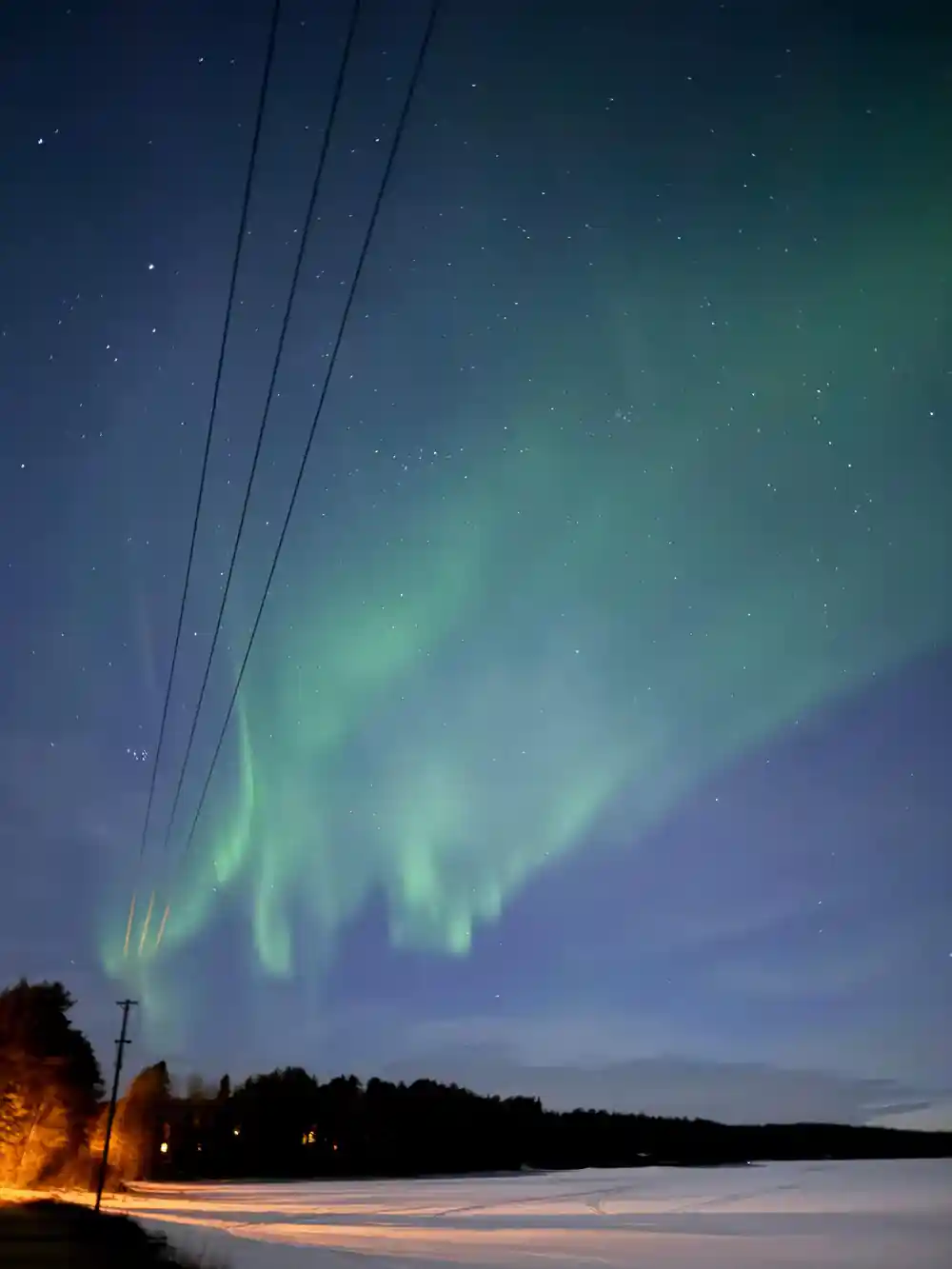
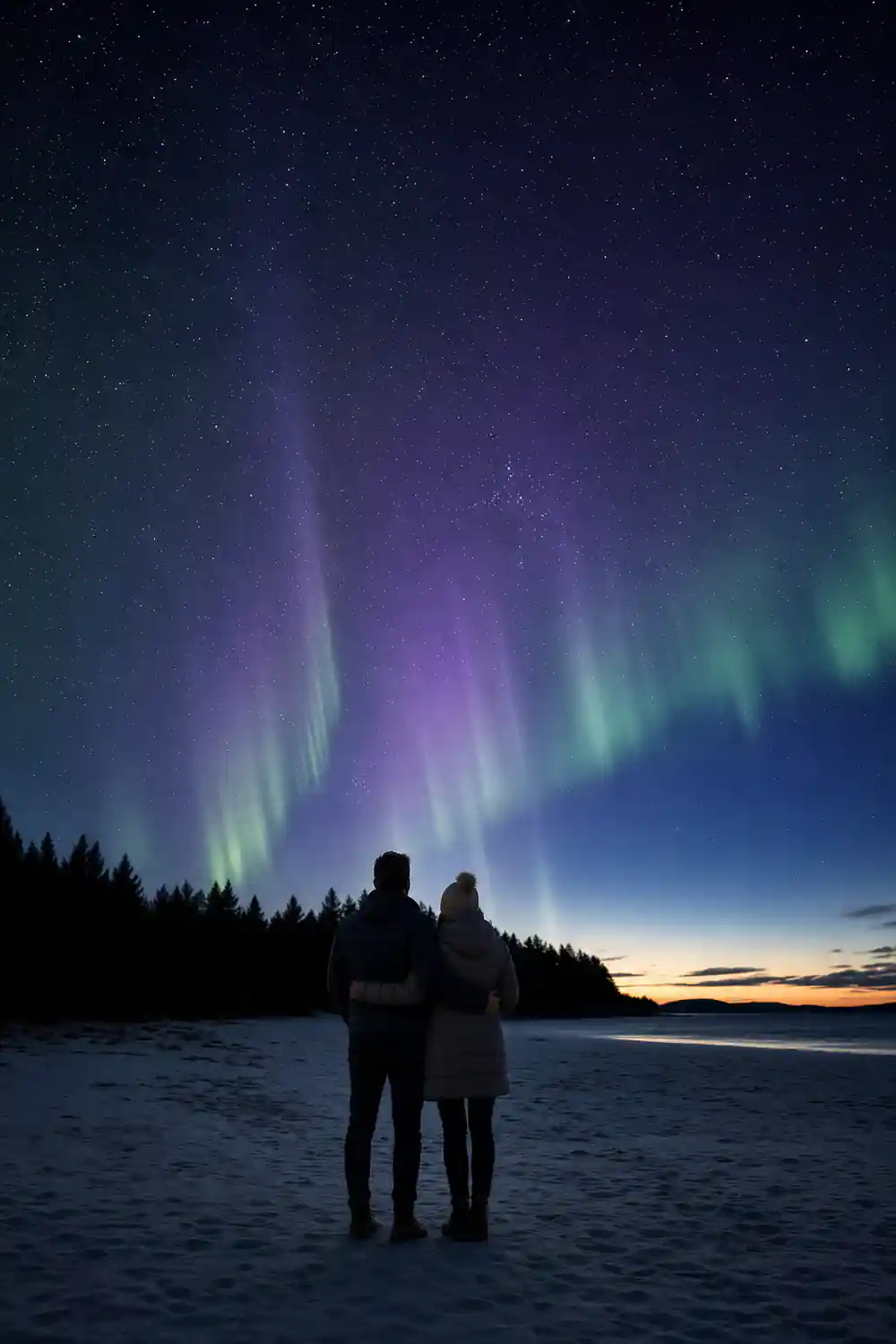
Latitude explains most of what follows here. Above the circle the sun behaves differently through the year, which is what creates kaamos, the long blue twilight of midwinter, and the bright nights of early summer that never quite go dark. It also puts Rovaniemi under the auroral oval often enough that a winter visitor has a realistic chance of seeing the northern lights, provided the sky clears when activity arrives.
Rovaniemi recorded 1.2 million overnight stays in 2023, up 30% on 2022, and December brings peaks of up to 10,000 airport arrivals per day, while Santa Claus Village receives over 600,000 visitors a year.[10] For the weeks around Christmas, book both a bed and a guide well before you book flights.
Deep cold: what January feels like in Lapland
In January the average temperature in Rovaniemi sits between -30 and -15 degrees Celsius.[5] Take those numbers seriously, but understand that they do not describe how cold behaves. Around minus fifteen, a walk is pleasant as long as you keep moving. Colder than that, the air feels thin, your first deep breath catches, and bare skin tells you about it within a minute or two.
The thermal suit is the piece of kit that changes everything. An insulated suit used for Arctic activities can be rated to minus 40, but a damp cotton base layer defeats its insulation.[11] So wool or synthetic next to the skin, cotton nowhere near it, and a spare pair of gloves in a pocket you can open while wearing gloves. Frozen fingers end evenings early, and no aurora is worth that.
Standing still is far colder than walking, and a night out can run long. Ask your guide for a spot near the fire if you feel the chill early, and drink something warm before you start. Many travellers find that the second hour outside is easier than the first, once the body has adjusted and the layers have done their work.
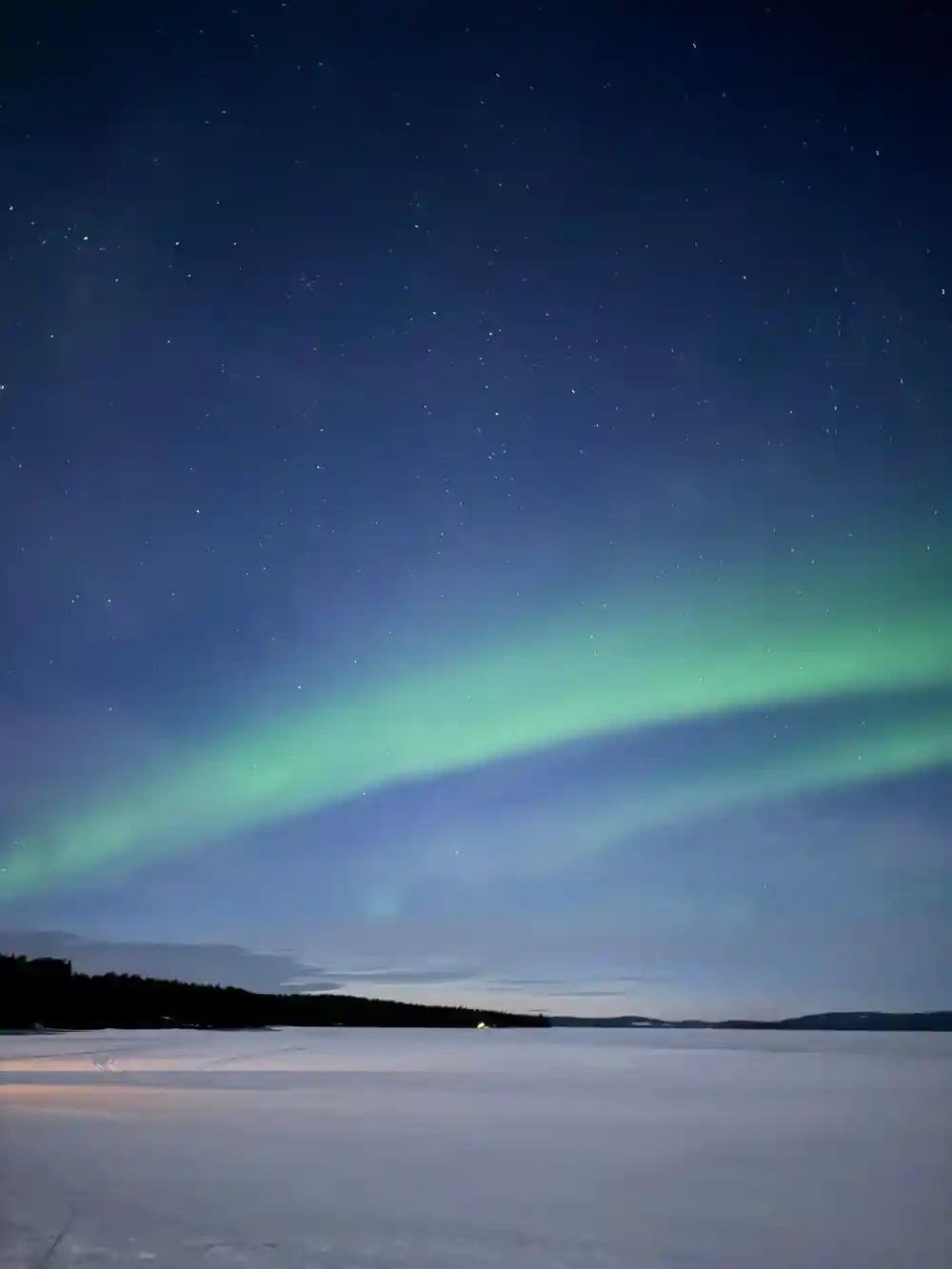
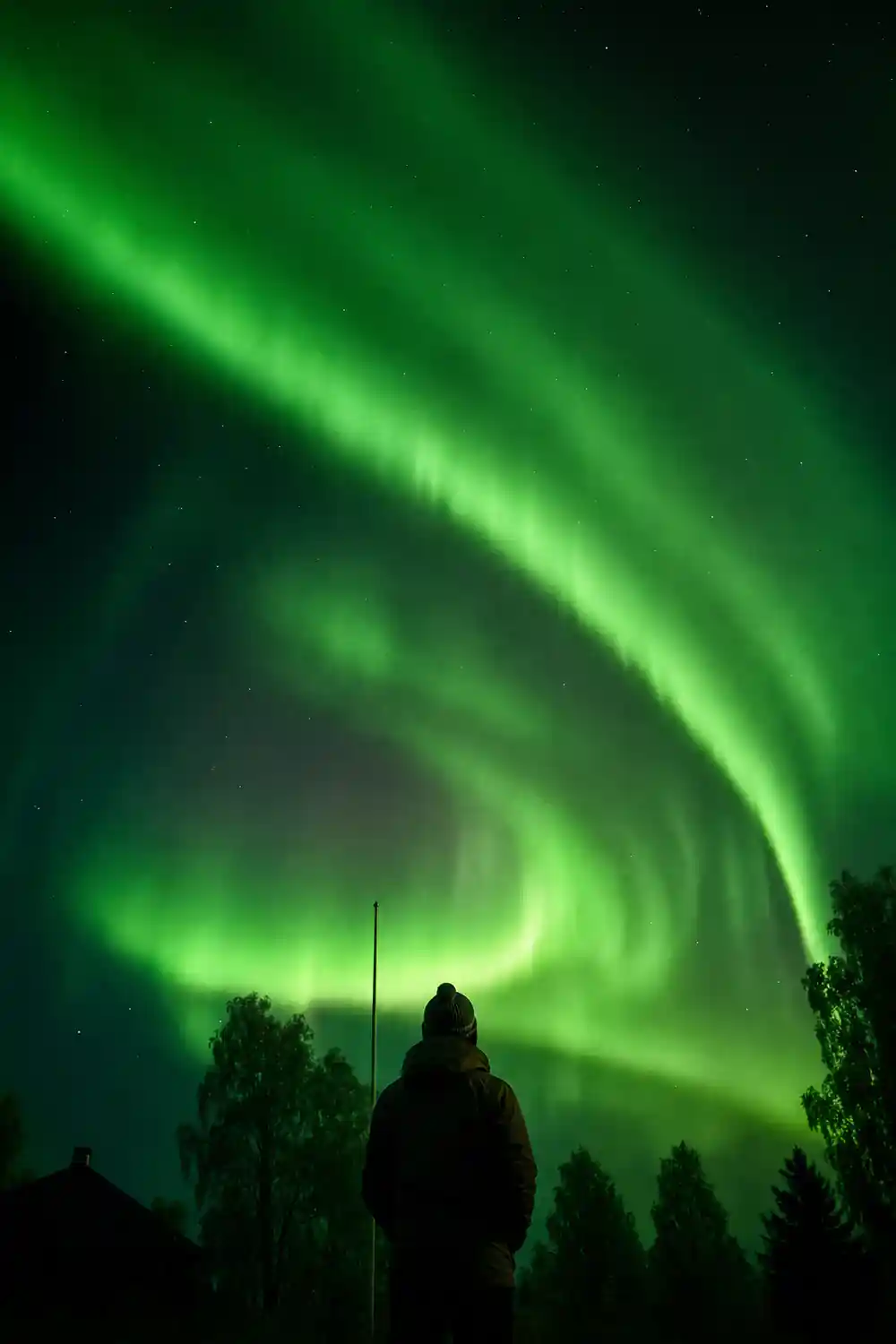
Snow-loaded forest and a green arc over Lapland
Kaamos: the blue twilight that replaces the sun
The polar night lasts for 2 days in Rovaniemi.[2] That is the whole period without a sunrise, which surprises people who expect weeks of black. Because the city sits on the Arctic Circle line, the sun only dips just below the horizon, and the rest of the winter still gets daylight: low, slanted, and often washed pink or lilac for an hour or two around midday.
Kaamos, as Finns call it, is better imagined as an extended blue hour than as night. It arrives late morning, glows across the snow, and fades in the early afternoon. It is also fine aurora weather, because the evenings are dark for many hours, the air is often still and clear, and there is no need to wait for midnight to find full darkness.
The aurora season is much longer than kaamos. Rovaniemi has visible aurora roughly 8 months a year, from late August through mid-April.[3] Solar scientists expect Solar Cycle 25 to have a double peak, extending the window for aurora activity well into 2026.[4] The shoulder seasons often give a better balance of dark skies and bearable temperatures than the depths of midwinter.
Frozen lakes and the ice that forms on them
Rovaniemi typically receives 150-200 cm of snowfall per winter, and the snowy part of the winter can last 6-7 months.[6] Lakes respond to that cold quietly. They freeze from the shallows outwards, then thicken through the dark weeks, and the surface changes character as the season goes on: glassy and black early, white and drifted later, ridged along the shore where the ice pushes and cracks.
If you plan to walk, ski or ride on a frozen lake, go with someone who knows that particular water body. Ice drumming under a snowmobile, cracks that run ahead of you and pressure ridges near the shore are all normal, but knowing which are harmless comes from local experience. Ice fishing and ice floating trips exist so that a guide carries that judgement for you.
The same landscape supports the herds that shaped Lapland. According to the Reindeer Herders Association in Finland, there were 186,776 reindeer in Finland in the reindeer husbandry year 2013-14.[12] In winter they move into the forests for lichen, and a snowmobile trail can turn a corner and find a herd standing quietly among the trees.
from US$228
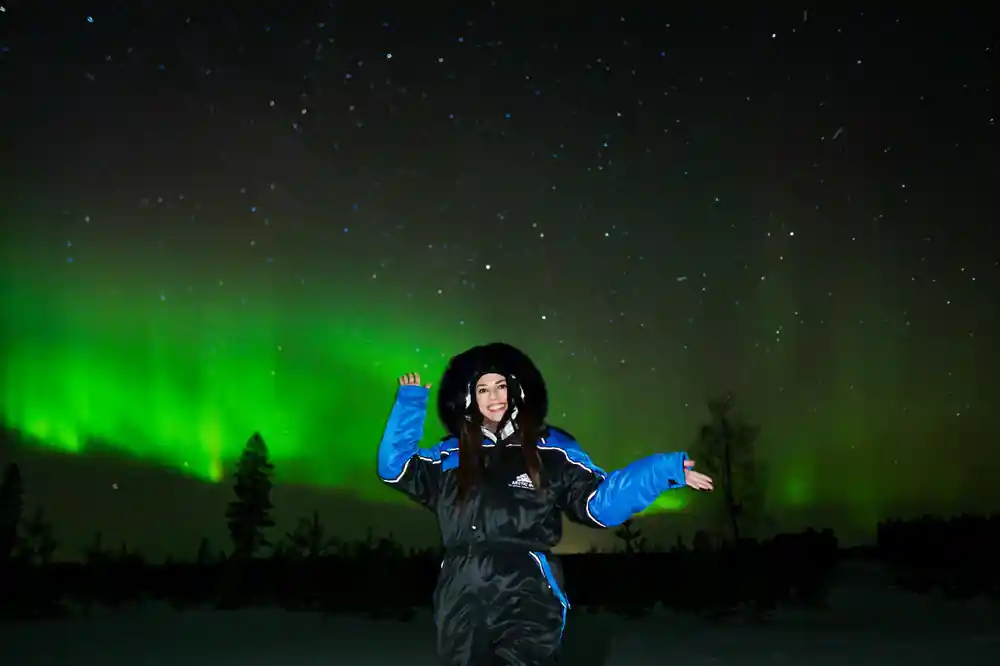
The tour booked from this site runs 8 hours for a small group, with pickup included and a refund if viewing is impossible.[7]
Why snow squeaks underfoot on the coldest nights
Snow is made of ice crystals, and when the air is very cold and dry, those crystals stay sharp and loose instead of packing into slush. Walk on them and they fracture and slide against each other, which is the squeak and crunch you hear on the coldest evenings. Sound carries further too, because cold air is dense and holds very little moisture to absorb it.
The dryness has other effects. Your breath hangs in front of your face, stars look unusually steady, and a conversation on one side of a frozen lake can be heard on the other. Camera batteries are the usual casualty, since they lose power quickly in deep cold, so keep spares in an inside pocket and swap them the moment the first one slows down.
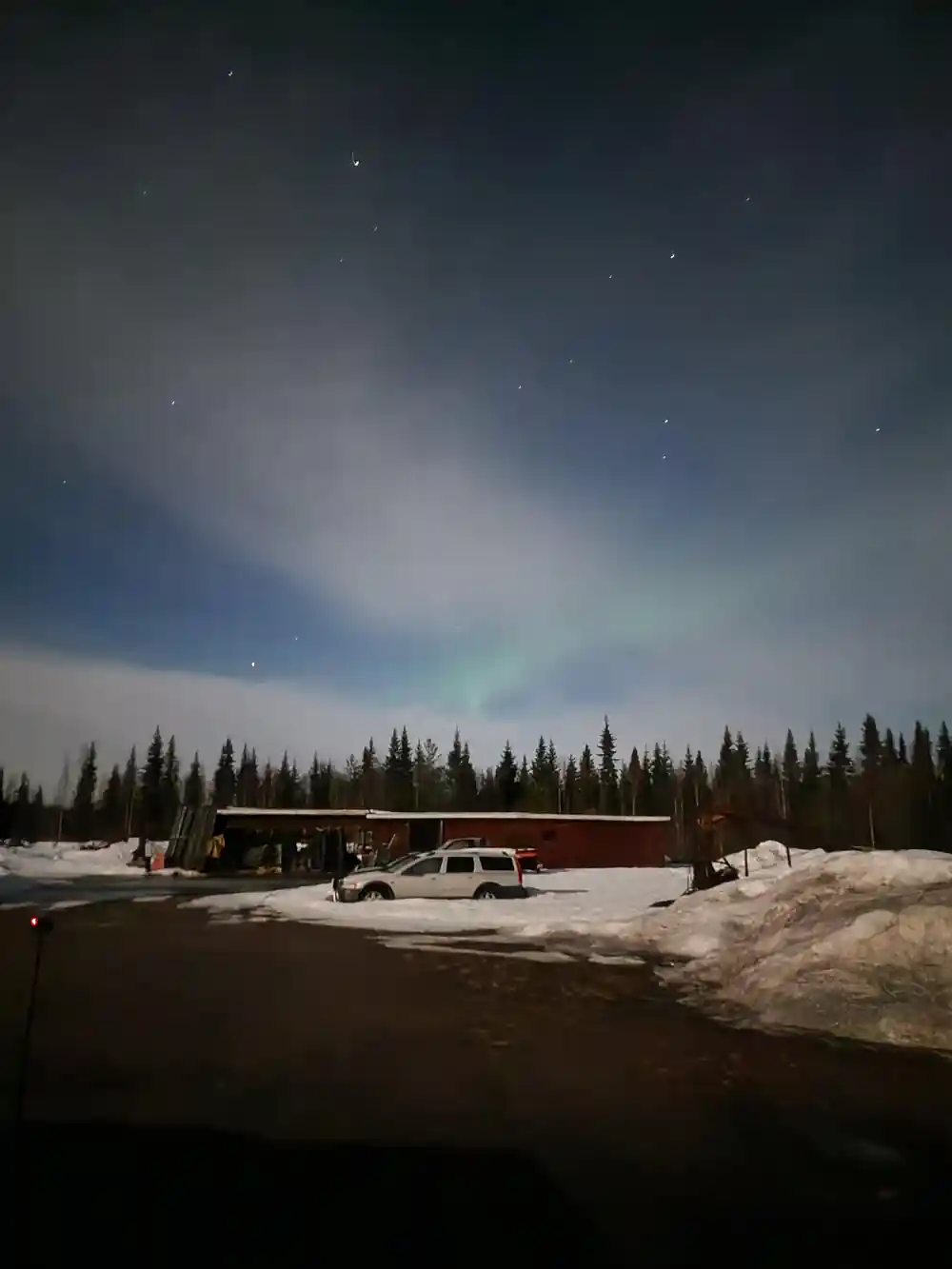
Snow also stores and returns light. A full moon over fresh snow is bright enough to walk by without a torch, and the long blue of kaamos spreads across ground that reflects the sky. A night walk on a forest trail often feels brighter than the forecast suggests, even when the aurora stays quiet.
Tykky: snow-loaded trees that line the forest
Above Rovaniemi the forest sometimes looks like a row of white sculptures, every branch and twig carrying its own thick collar of snow. Finns call it tykky, and it builds when damp air freezes onto branches, layer on layer, before snow settles on top. It is heavy enough to bend birches into arches over the trail, and the tracks beneath them feel like tunnels.
Those tunnels are where aurora hunters want to end up. A clearing in a snow-loaded forest gives you a dark northern horizon, and snow reflects light, so on a strong night the whole trail can glow faintly green. Give your eyes several minutes to adjust, keep to the packed track, and watch your footing when you look up.
Tykky is temporary. Warm spells and wind knock it down, and a day of heavy snow can rebuild it in different shapes, so the forest rarely looks the same twice in one week. Guides read those changes as they drive, looking for a stop that is open to the north and sheltered from the wind at the same time.
Frost on eyelashes, lenses and why it matters
Breathe out through a scarf on a cold night and the moisture freezes in the fibres, then on your eyelashes. Lenses behave the same way: carry a camera from a warm car into the cold and the glass fogs, then frosts over. Let it equalise inside the bag, bring it out when you actually stop, and try not to breathe across the front element while you check settings.
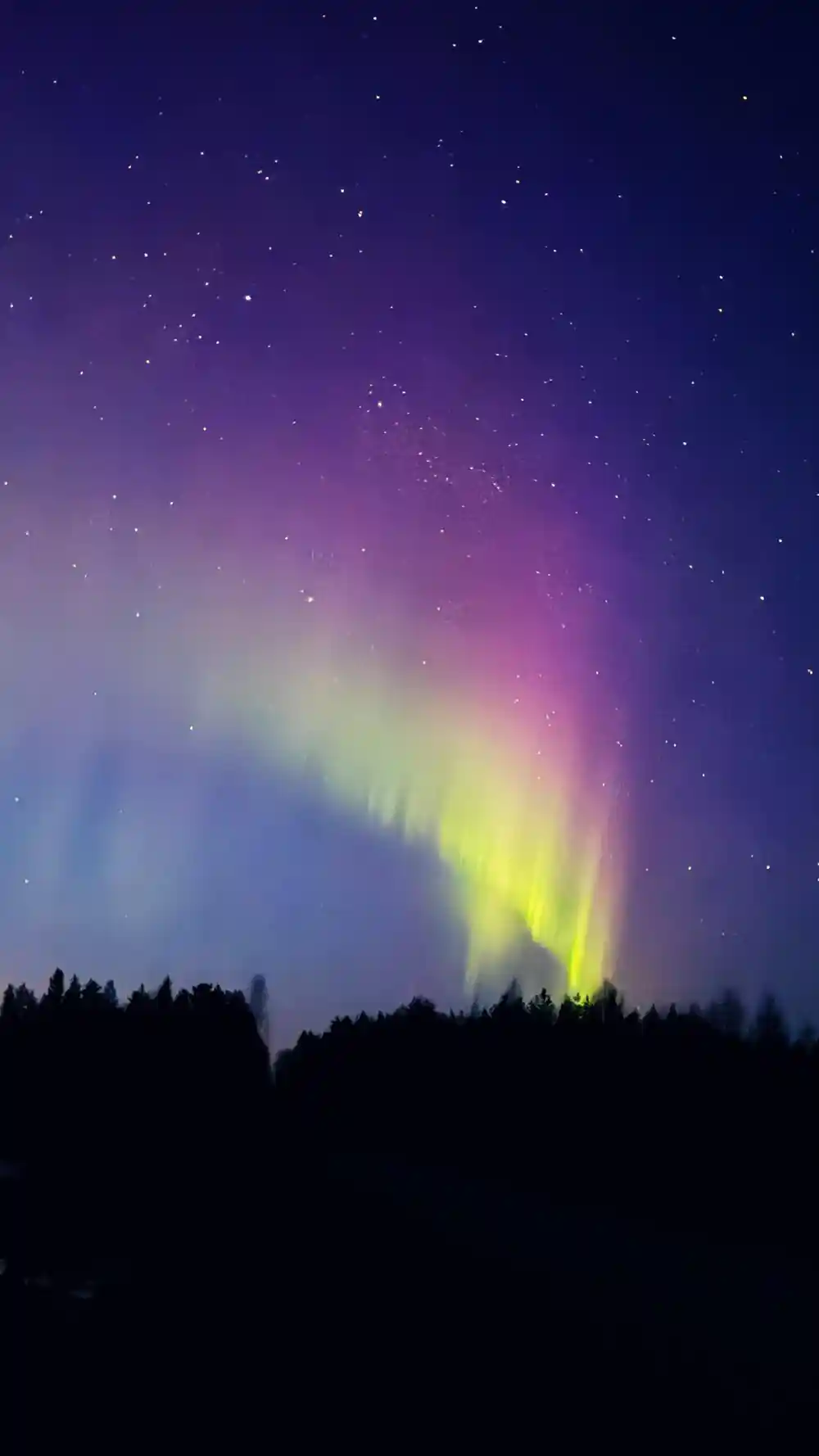
Finnish tradition calls the northern lights revontulet, literally fox fires, and a Sami legend says the lights are caused by a magical fox running across the Arctic fells.[13] The colours have their own explanations. Green comes from oxygen at 100-150km, red from oxygen above 200km, and violet from ionized nitrogen below 100km.[14] None of that makes a display better, but it explains why some nights are a pale arc low on the horizon while others pulse overhead.
It all begins high above you. Auroras are caused when fast-moving electrons collide with atoms and molecules in Earth's upper atmosphere above 100 km (60 miles), transferring energy that excites them to higher energy states.[15] Forecasters sum up conditions with the Kp index, which ranges from 0 to 9; for Kp 0-2 the aurora will be far north, quite dim, and not very active.[16] Every so often something stranger appears. STEVE, a narrow mauve ribbon far equatorward of the auroral oval, is produced by a channel of westward-drifting ions heating the atmosphere rather than by particle precipitation.[17]
Polar night: days without a sunrise
Days of polar night at each place, as reported by Safartica.[2]
Aurora tours from Rovaniemi in US dollars
US dollar from-prices taken from GetYourGuide listings; child rates are not listed separately.[7][8][9][18]
When to go for aurora and cold
Plan your aurora night
Check the forecast
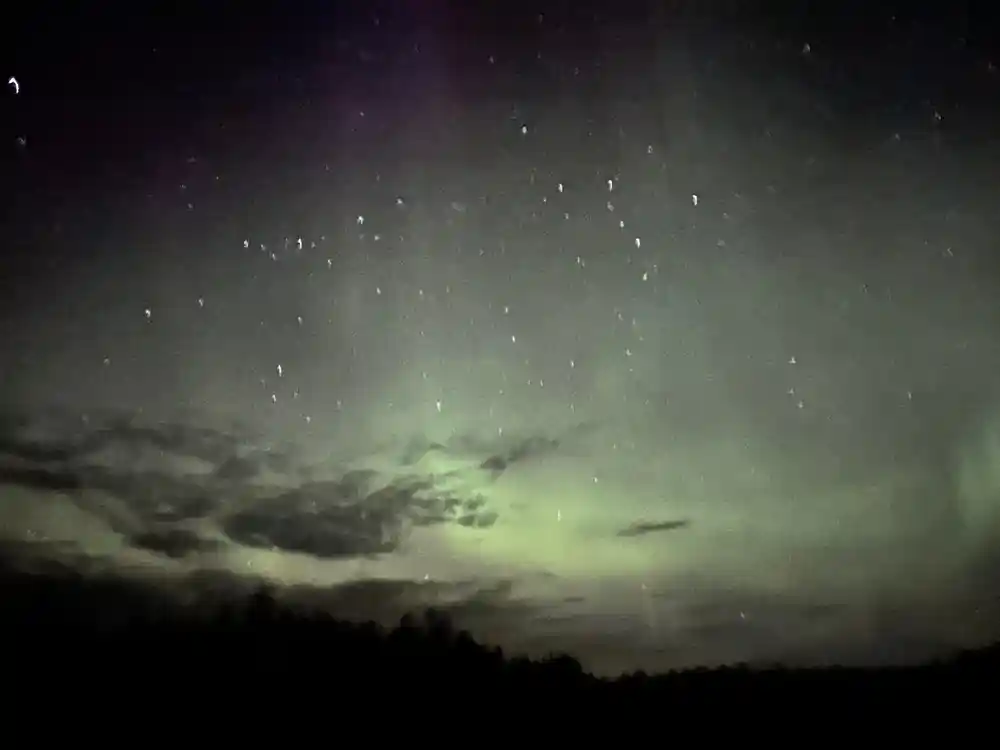
Look at the Kp index before you go out. For Kp 0 to 2 the aurora will be far north, quite dim, and not very active, which is worth knowing before you drive anywhere.[16]
Choose your window
Aurora is visible roughly 8 months a year, from late August through mid-April. Midwinter is not your only option.[3]
Dress for deep cold
An insulated suit rated to minus 40 still fails if a damp cotton base layer sits against your skin.[11]
Book a guaranteed hunt
The tour this site books runs 8 hours, limited to 8 participants, from US$228, with a refund if viewing is impossible.[7]
Confirm the practical bits
Pickup is included, and free cancellation runs up to 24 hours in advance if your plans change.[7]
Hold a place on the guaranteed aurora hunt
from US$228Reserve now & pay later